

Ideally, a sales team would be motivated, efficient and productive.
As a sales company owner, even if you've done everything in your power to optimize your department's sales processes, if your salespeople are still using spreadsheets, manual contact lists, communication channels on several different platforms, and various calendars and reminders, their effectiveness is far from its potential.
But how to reach it? The answer is a functional CRM system that will automate a large part of the sales processes and unite all the necessary tools in one platform. This way, your salespeople will focus on selling, as they will have much more time to do so. That's real efficiency.
Here's a study by Finance Online that proves the overall benefit of CRM for sales-oriented companies.
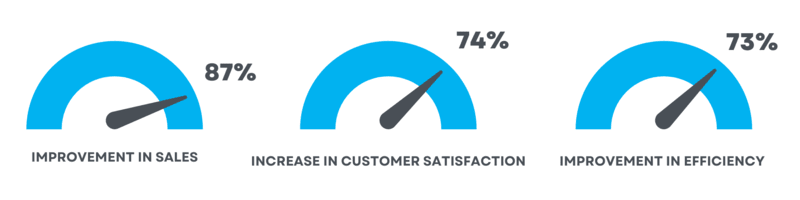
Implementing CRM software in your sales department is an investment worth-making. Let's explain in detail why…
Sales CRM Introduction
In the field of commercial activity, CRM is a system that optimizes sales processes through customer-focused functionalities and data. Every interaction with the clients is managed and documented by the CRM software - from phone calls and lead identification, to the closing of a deal, sales volume and analyzing salespeople in terms of their productivity.
The ability to automate processes such as Lead Management, Opportunity Management and more helps your sales team focus less on administrative tasks and more on sales themselves.
In other words, Sales CRM is a tool to quickly close more deals and shorten the sales cycle, and one that helps effectively manage the overall sales activity in your company.
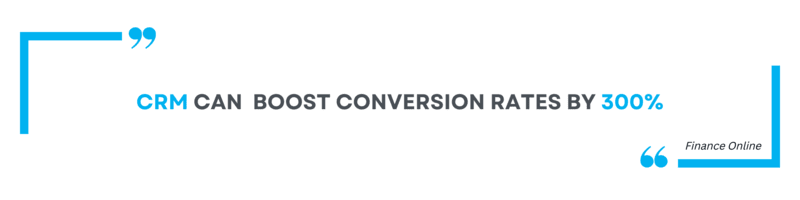
A serious indicator of this is the claim of Finance Online, which shows how the capabilities of a CRM system can optimize the percentage ratio between leads and sales, i.e., closing more deals.
Sales and CRM – a match made in heaven
Sales and CRM go hand in hand, but to get to the essence of why a CRM system is so useful for sales teams, we first need to understand a salesperson's day-to-day workflow and how CRM improves it.
Salespeople are extremely busy and with high work dynamics. They simultaneously connect with new customers, maintain relationships with existing ones and take care of converting leads into potential customers.
We live in such times where all customers, regardless of their status, expect accurate and timely feedback, and this is extremely difficult to achieve when dealing with many people at the same time.
Sales CRM is the perfect tool for all the challenges a salesperson faces on a daily basis. With just a few clicks, a Sales CRM can provide a salesperson with the complete picture for every single lead or customer, making day-to-day customer relationship management easier and more efficient.
Let's take a look at 5 key benefits of Sales CRM for sales teams.
1. Optimize the sales processes with Lead Management
Without Sales CRM, the classic way to acquire new leads is through the company's marketing activities. A campaign is created that generates leads through various channels such as email, social networks or landing pages with a contact form. The collected data goes to the Marketing department, which then provides it to the sales team. They, in turn, determine the quality of the collected leads and contact the selected ones directly.
When a Sales CRM is available, the marketing department can create campaigns again, but the rest of the processes are automated. Here is an example of such Lead Management:
- Collecting Leads - performed automatically by the CRM, which sorts them depending on the channel they came from or by other criteria such as industry, type of business, location, etc.
- Lead Management – the sales team has full access to all data at any time.
- Reminders – reminders can be placed on different leads, as well as certain leads can be assigned to specific salespeople.
Meanwhile, Sales CRM tracks and documents all salespeople's conversations, emails, and messages with leads and current customers for management monitoring and process improvement.
2. Sell from anywhere
Salespeople often work from home or are mobile most of the time. That's why they need tools they can access no matter where they are.
Most CRM systems are offered as cloud-based solutions, making them accessible from anywhere. It is enough the salesperson to have access to a computer and the Internet.
Mobile CRMs as apps are also increasingly common, thanks to which salespeople can manage leads, customers and sales processes from their smartphones or other devices.
3. Shorten the sales cycle and identify opportunities for upselling and cross-selling
Thanks to detailed records, every salesperson has a 360-degree view of their customers at all times. This enables anyone on the sales team to quickly and easily identify and implement upselling and cross-selling opportunities, both of which increase both sales revenue and customer satisfaction.
The combination of important contacts, sales data and detailed information on actions taken until the particular date makes each salesperson well prepared for every business meeting and helps them close more deals quickly and shorten the overall sales cycle.
4. Encourage teamwork
Since all customer information is gathered in one place in Sales CRM, all employees of different departments in your company have full access to it and can work on one customer's file at the same time, if necessary.
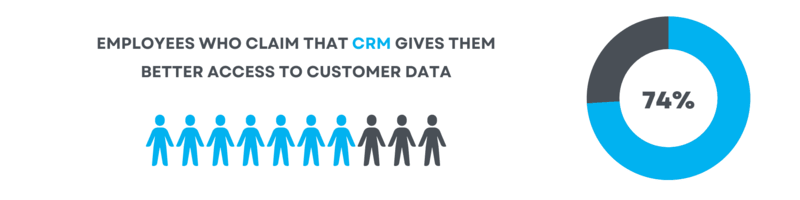
According to the statistics from Software Advice, 2/3 of employees using a CRM system in their company say that it gives them significantly better access to customer information.
A great example of teamwork with CRM is the collaboration between the sales team and the marketing department. If, for example, marketers notice that most of sales are generated by email, they can focus on campaigns on this communication channel, which will result in higher quality leads.
5. Analyze and forecast
The CRM system allows sales team members to gain deeper insight into their goals and how they are performing, as well as to track lead sources, sales volume and sales cycles, and analyze the competition.Managers, on the other hand, have the ability to identify the most successful salespeople based on productivity, missed and closed deals and work speed.The CRM solution has specialized panels called Sales Dashboards, which give a complete, clear and up-to-date picture of every element of the sales activity. This helps to make faster, accurate and adequate management decisions.
Who should use Sales CRM?
All industries doing both B2C and B2B sales would benefit from the system. Although sales cycles and processes vary for the different industries, Sales CRM would be useful for any business in its sales part.
Here are some common aspects that all companies, regardless of the industry, would like to improve:
- The need to track and manage customer information
- Streamlining communication between different departments and teams
- Processing a large volume of documentation
- Methods for preparing accurate and clear sales reports
A CRM solution would go a long way in addressing these and many other sales and in-house challenges that every business faces.
Find out more about how InfoServ CRM would increase the efficiency of your company's sales processes and request a free demo to see its capabilities in the Sales department.