

Turnover Calculation
Truth to be told, voluntary employee turnover is never a good sign. Moreover, it is associated with time and costs of hiring a new person, and on the other hand, it disturbs the balance of the work process.
Every business suffers more or less from employee turnover, but in contact centers it is very prominent. This is often due to the high intensity of work, in combination with other factors that influence the employee to make this decision.
There is a specific formula for calculating turnover in percentages. You need to know how many agents left the company over a period of one year, and what the average number was.
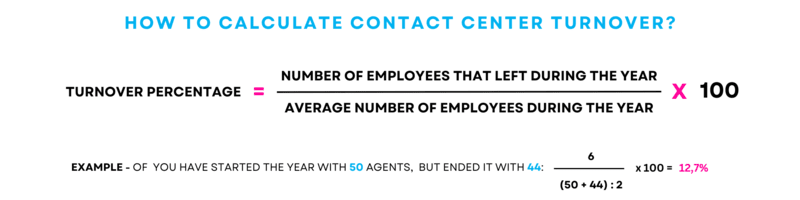
This formula will give you an overall view of the state of the contact center in terms of staff turnover and will help you in making management decisions to reduce it if the percentage is not satisfactory as a result.
What are the Main Reasons of Contact Center Turnover?
1. Lack of confidence and motivation
Contact center agents spend most of their time answering calls and handling inquiries, which can lead to a feeling of monotony in their duties.
If employees are not allowed to improvise in their communication with customers or are not trained well to handle cases, they start to feel helpless and incompetent. And when they can't meet customers' expectations, they begin to feel demotivated and the desire to leave grows.
2. Poor organizational culture
It's easy for agents to feel isolated in an environment where they spend most of their time on the phone and staring at their monitors.
A good team culture and close relationships with coworkers would help them feel more socialized. When agents communicate with each other, they learn from each other, which contributes to their job satisfaction and positively influences motivation.The problem is that most contact centers do not tolerate this kind of relationship between employees, which leads to mutual alienation and makes them consider new career opportunities.
3. Lack of recognition
Another major problem with most contact centers is that management puts more emphasis on service issues than on performance and positive results. If, for example, a customer complains about poor service, it will get much more attention than if several customers praise the professionalism of the agents, and the latter will rarely be acknowledged.
One of the reasons for this may be a lack of sufficient managers to identify their team's achievements. But either way, a lack of recognition doesn't help retain employees, and if the trend continues, they start looking for something new.
4. Unfair and subjective treatment
Call center solutions have multiple metrics to evaluate each employee's performance, but that doesn't mean managers will be fair in their feedback to agents. This subjective assessment does no good and benefits no one. On one hand, this can affect the increase in pay or rank, and on the other, employees begin to lose trust in managers more and more.
When it gets to that point, the agents start to realize that there is no future for them in the company and decide to take a new career path.
How High Turnover Affects Contact Centers
• High hiring and training costs
Every time an agent leaves, a new employee must be hired in their place. If the turnover is high, this is associated with considerable costs of hiring new staff and their training. In fact, a study by American Progress indicates that the entire process of hiring a replacement for a departing employee costs a company about 20% of an annual salary.
• Reducing the quality of customer service
When already experienced and trained agents leave, in their place come new ones who are yet to learn the nature of the work and how to deal with clients and handle specific cases. This incompetence can lead to more service issues, resulting in lower customer satisfaction.
• Disturbed team spirit
When employees witness high turnover, it affects them emotionally. On the one hand, they constantly have to get used to new people, and on the other hand, as "old" personnel, they have to handle and resolve more complex customer cases, which impacts their workload.
The cohesion of the team is of particular importance, because it helps to have a better focus and a higher motivation. It is difficult to build solid collegial relationships when the turnover is high.
• KPI and/or Upselling and Cross-Selling issues
Turnover definitely has a negative impact on achieving the desired KPIs.
"First Call Resolution", "Average Inquiry Processing Time" and "Call Duration" are some of the first Call Center metrics to be affected.
Not only will new agents find it difficult to quickly grasp the contact center's work style, but they may also fail to notice the opportunities for upselling and cross-selling when talking to a customer, if the center's activity is sales-related. These skills come with time and experience.
• Difficulties in implementing new technologies
Let's be honest - sometimes new employees need at least a month to get into your work style and learn how to operate with the Call Center solution you've implemented.
This will certainly reflect on the quality of customer service and the overall user experience associated with call center interactions.
If, on the other hand, you are considering an upgrade of the software solution the call center works with, or you are about to implement a new, better one, wait for a suitable time for this – when there are no recently hired employees in the team. Otherwise, it would have a negative impact even on the experienced agents, because apart from new colleagues and more work, they will also have to get used to a new system.
How to reduce turnover?
So far, we've discussed the most significant reasons for contact center turnover and its negative impact on workflows and customer service. What is the solution for its reduction? There is no straight answer to this question, but in the continuation of this material, we share 10 simple but valuable tips that will help you keep experienced agents longer, without them often considering new career opportunities.
Find out what they are and the positive outcomes they bring HERE.